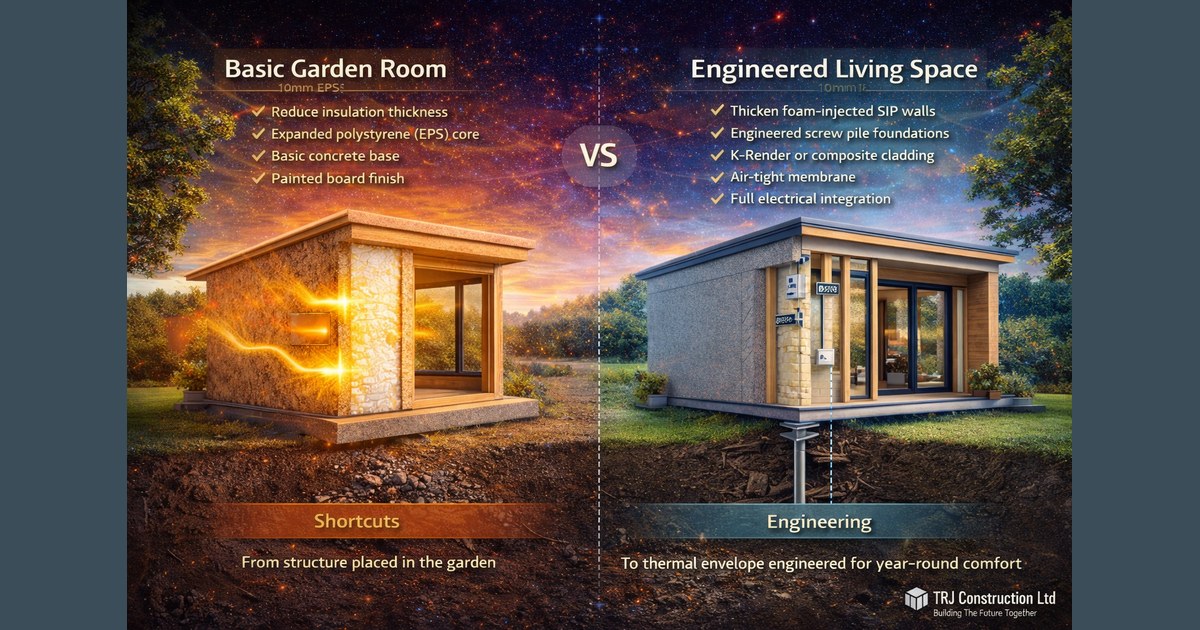
EPS vs Foam-Injected PUR/PIR SIP Panels – The Core of the Matter
When comparing Structural Insulated Panels (SIPs) for garden rooms or granny annexes, most discussions focus on thickness.
But thickness is only part of the equation.
The insulation core type inside the SIP panel plays an equally critical role in long-term thermal and structural performance.
The most common core materials are:
- EPS (Expanded Polystyrene)
- Foam-injected PUR or PIR (Polyurethane / Polyisocyanurate)
Understanding the difference is essential when specifying a SIP building for year-round residential use.
What Is EPS in SIP Panels?
EPS (Expanded Polystyrene) is widely used in SIP construction.
It is:
- Stable
- Cost-effective
- Lightweight
- Can be used in engineered building systems for different uses, subject to the full specification and approvals.
EPS-based SIP panels are commonly found in entry-level garden rooms designed to meet a price point.
EPS is not limited to seasonal buildings. Assess the complete system against the thermal, structural and fire requirements for the proposed use.
But performance depends on application.
What Makes Foam-Injected PUR/PIR Different?
Insulation performance differs between products. Compare the manufacturer’s declared conductivity and calculated whole-element U-value; do not infer density, bonding or structural performance from the core name alone.
Lower lambda value = lower heat transfer.
In practical terms:
- For the same panel thickness, PUR/PIR typically achieves a better U-value than EPS
- For the same target U-value, PUR/PIR allows a thinner structural build-up
That means more thermal resistance per millimetre.
In colder climates — including North London, Hertfordshire and the surrounding counties — that difference becomes significant during winter.
EPS vs PUR/PIR: Thermal Performance Comparison
While exact performance depends on full build-up and specification, typical thermal conductivity ranges are:
- Use the declared conductivity for the chosen EPS product rather than a universal material range.
- Use the declared conductivity for the chosen PUR/PIR product and account for the full build-up.
This reduction in lambda value directly improves U-values and overall thermal efficiency in SIP buildings.
The result?
- Lower heat loss
- Reduced heating demand
- Improved internal temperature stability
For granny annexes designed for full-time residential use, that performance gap matters.
Structural Advantages Beyond Insulation
Thermal performance is only one aspect.
Foam-injected PUR/PIR SIP systems often provide:
- Compare the tested compressive strength of the specific products.
- Improved dimensional stability
- Bonding integrity depends on manufacture and quality assurance for the specific system.
- Fire classification applies to a tested product or assembly, including its facings and linings; it is not established by the foam type alone.
Because a SIP panel acts as a composite structural element, the bonding integrity between core and skins is critical.
Higher-density cores can contribute to improved long-term rigidity and reduced deflection.
In annexes and extensions intended for permanent living, that structural consistency becomes part of long-term durability.
Why Core Choice Matters for Granny Annexes
When designing granny annexes in Hertfordshire or North London, insulation decisions are not academic.
They directly influence:
- Winter comfort
- Heating system sizing
- Running costs
- Condensation control
- Long-term structural behaviour
A building used occasionally in summer can tolerate compromises.
A building used as full-time accommodation cannot.
How We Specify SIP Core Types at TRJ Construction Ltd
At TRJ Construction Ltd, core specification is determined by intended use — not by minimum cost.
For annexes intended for:
- Full residential occupation
- Multi-generational living
- Therapy rooms or home offices used daily
We prioritise higher-performance insulation cores where appropriate.
Because the envelope determines comfort.
And the envelope is defined not just by thickness — but by core material, bonding quality and installation precision.
Performance Is Engineered, Not Assumed
All SIP panels may look similar externally.
But:
Core type matters.
Lambda value matters.
Bonding consistency matters.
Application matters.
Performance is not automatic.
It is specified.
And that specification defines whether a building is:
A structure placed in a garden
Or
An engineered living space designed for year-round use.
Sources and project-specific guidance
Check the current guidance and the actual project specification. Performance, cost and approval depend on the complete design and site.